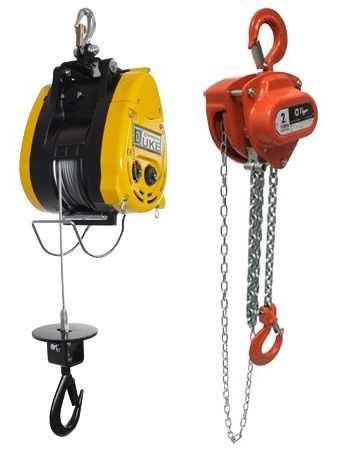
Choosing the right hoist is a decision that directly affects productivity, safety, and long-term operating costs. Whether you are outfitting a workshop, a manufacturing floor, or a maintenance facility, the choice between electric and manual hoists deserves careful analysis. Both options have distinct strengths, and the “better” choice depends entirely on your lifting requirements, duty cycles, and budget. This guide breaks down the key differences so you can make an informed decision.
Understanding the Core Difference
Manual hoists rely on human power—typically via a hand chain or lever—to lift and lower loads. Electric hoists use a motorized system controlled by push-button pendants or remote controls. That fundamental distinction cascades into every practical consideration: speed, capacity, cost, and operator fatigue.
Performance and Productivity
When throughput matters, electric hoists hold a clear advantage. Motorized lifting is faster, smoother, and consistent regardless of load weight. Operators can move heavy loads with minimal physical effort, which reduces fatigue over long shifts and supports higher production rates.
Manual hoists, by contrast, are slower and demand physical exertion. For occasional lifts or low-volume operations, this is rarely a problem. But in environments where loads move frequently—assembly lines, loading docks, or busy machine shops—the time lost to manual operation adds up quickly.
Duty Cycle Considerations
Electric hoists are rated by duty cycle (e.g., H2, H3, H4), which defines how long they can run within a given period. High-duty applications demand hoists rated for frequent, sustained operation. Manual hoists have no motor to overheat, so they can technically be used indefinitely—but the operator’s stamina becomes the limiting factor.
Cost Analysis: Upfront vs. Lifetime
Budget discussions around hoists often focus on purchase price, but total cost of ownership tells a fuller story.
| Upfront Cost | Lower | Higher |
| Installation | Simple | Requires power supply and wiring |
| Maintenance | Minimal | Periodic inspection and servicing |
| Labor Cost per Lift | Higher (operator time) | Lower (faster cycles) |
| Lifespan | Long with proper care | Long with scheduled maintenance |
Manual hoists win on initial investment and simplicity. Electric hoists cost more upfront and require power infrastructure, but they often pay for themselves through labor savings and increased throughput in high-volume settings.
Safety and Ergonomics
Safety is non-negotiable in any lifting operation. Electric hoists reduce the risk of musculoskeletal injuries associated with repetitive pulling and cranking. Push-button controls keep operators at a safer distance from the load, and features like limit switches and overload protection add layers of security.
Manual hoists are safe when used correctly, but they place physical strain on the operator and require careful load control. Lever hoists offer precise positioning, which can be an advantage in rigging and tensioning tasks, but sustained manual lifting increases fatigue-related risk.
Environmental Factors
Consider your operating environment. In hazardous locations with flammable gases or dust, spark-resistant manual hoists or specially rated explosion-proof electric hoists may be required. In cleanroom or washdown environments, sealed electric models often prove more practical. Outdoor or remote sites without reliable power favor manual hoists.
When to Choose a Manual Hoist
- Intermittent use: Occasional lifts in garages, small workshops, or maintenance bays.
- No power access: Remote locations, field work, or areas without electrical infrastructure.
- Precise positioning: Lever hoists excel at controlled tensioning and rigging.
- Tight budgets: When upfront cost is the primary constraint.
- Portability: Lightweight manual units are easy to transport and relocate.
When to Choose an Electric Hoist
- High duty cycles: Repeated lifting throughout the workday.
- Heavy loads: Capacities that make manual lifting impractical or unsafe.
- Productivity targets: Operations where speed directly affects output.
- Operator welfare: Reducing physical strain and fatigue across shifts.
- Fixed installations: Overhead cranes and workstation systems with reliable power.
Key Selection Criteria
The Bottom Line
There is no universal winner in the electric versus manual hoist debate—only the right tool for the job. Manual hoists deliver simplicity, portability, and low upfront cost for occasional or remote lifting tasks. Electric hoists provide speed, reduced operator strain, and higher throughput for demanding, repetitive operations.
Evaluate your duty cycle, load requirements, environment, and labor economics before committing. When in doubt, consult a hoist specialist who can match equipment specifications to your actual operating conditions—because the safest and most cost-effective hoist is always the one correctly sized for the work.
Leave a Reply