In the world of industrial lifting equipment, two names dominate the conversation: overhead cranes and gantry cranes. Both are indispensable workhorses in manufacturing plants, warehouses, construction sites, and shipping yards. Yet despite their shared purpose—moving heavy loads safely and efficiently—they differ significantly in structure, installation, and ideal use cases. Choosing the wrong type can lead to unnecessary capital expenditure, compromised workflow, or even safety risks. This article breaks down the key differences between overhead cranes and gantry cranes so you can make an informed decision for your operation.
What Is an Overhead Crane?
An overhead crane, also known as a bridge crane, is a lifting system that runs on elevated runways or tracks mounted to the building’s structural columns. The crane consists of a bridge girder that spans the width of the runway, with a hoist and trolley assembly that travels along the bridge. This configuration allows the crane to move loads in three dimensions: longitudinally along the runway, laterally across the bridge, and vertically via the hoist.
Overhead cranes are permanently integrated into the facility. They are typically found in:
- Manufacturing and assembly plants
- Steel mills and foundries
- Warehouses requiring high-throughput material handling
- Power generation facilities
- Paper mills and heavy industrial operations
Advantages of Overhead Cranes
- Superior floor space utilization: Because the crane travels above the workspace, the floor remains clear for personnel, machinery, and storage.
- High lifting capacities: Overhead cranes can handle loads ranging from a few tons to several hundred tons.
- Precise load control: The rigid bridge structure enables smooth, accurate positioning of loads.
- Long service life: With proper maintenance, overhead cranes can operate reliably for decades.
Limitations of Overhead Cranes
- Building-dependent installation: The runway structure must be supported by the building’s columns, which requires significant structural engineering.
- High upfront cost: Installation involves substantial civil work and structural modifications.
- Not portable: Once installed, an overhead crane cannot be relocated without major dismantling.
What Is a Gantry Crane?
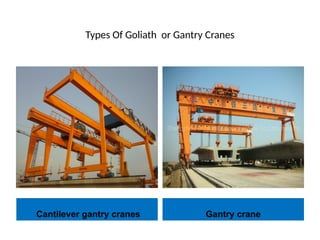
A gantry crane is a lifting system in which the bridge is supported by legs that travel on ground-level rails or, in some configurations, on rubber tires. Instead of hanging from a building’s structure, the gantry crane stands on its own frame—like a giant portal or archway that straddles the work area.
Gantry cranes come in two primary configurations:
Common applications include:
- Shipyards and port terminals (ship-to-shore and yard gantries)
- Construction sites for precast concrete and heavy materials
- Outdoor storage yards
- Temporary or leased facilities where permanent installation is impractical
- Rail yards and intermodal terminals
Advantages of Gantry Cranes
- Facility independence: Gantry cranes do not rely on building structure for support, making them ideal for outdoor or temporary applications.
- Portability: Many gantry cranes, especially smaller models, can be relocated or disassembled with relative ease.
- Cost-effective for certain sites: When a building cannot support an overhead runway system, a gantry crane may be the more economical choice.
- Outdoor capability: Gantry cranes are well-suited for open-air environments such as ports and construction sites.
Limitations of Gantry Cranes
- Floor space requirements: The legs and ground rails occupy valuable floor space and can obstruct traffic flow.
- Weather exposure: Outdoor gantry cranes are subject to wind, corrosion, and temperature extremes, requiring more robust maintenance.
- Lower travel speeds: Many gantry configurations operate at slower speeds than overhead bridge cranes.
- Foundation requirements: Ground rails require properly engineered foundations to ensure stability and alignment.
Overhead Cranes vs Gantry Cranes: Side-by-Side Comparison
| Support structure | Building columns and elevated runway | Self-supporting legs on ground rails or tires |
| Installation | Permanent, structurally integrated | Portable or semi-permanent |
| Floor space impact | Minimal—operates overhead | Requires floor space for legs and rails |
| Indoor/outdoor use | Primarily indoor | Indoor and outdoor |
| Upfront cost | Higher (requires building modifications) | Lower to moderate |
| Relocation | Difficult and costly | Feasible for many models |
| Typical applications | Manufacturing, warehousing, steel mills | Ports, construction, storage yards |
How to Choose the Right Crane for Your Operation
Selecting between an overhead crane and a gantry crane ultimately comes down to your facility, workflow, and long-term operational goals. Consider the following factors:
Final Thoughts
Overhead cranes and gantry cranes are both proven solutions for heavy material handling, but they serve different operational realities. Overhead cranes excel in permanent, high-throughput indoor environments where floor space is valuable and precision is paramount. Gantry cranes shine in outdoor, temporary, or structurally constrained settings where flexibility and facility independence matter most. By carefully evaluating your building, workflow, and lifting requirements, you can select the crane type that delivers the greatest safety, efficiency, and return on investment for your business.
Leave a Reply