For technology-driven businesses, equipment decisions carry significant financial weight. Whether you are outfitting a film production crew, a construction firm, an IT department, or a medical imaging lab, the question of whether to rent or buy equipment can shape your cash flow, operational agility, and long-term profitability. There is no universal answer—but there is a disciplined way to reach the right one. This guide breaks down the key factors that should inform your decision.
Why the Rent-or-Buy Question Matters More Than Ever
Technology cycles are compressing. A piece of hardware that represented a major capital investment three years ago may now be obsolete or available at a fraction of its original price. Meanwhile, supply chain volatility and rising financing costs have made capital preservation a strategic priority for many organizations. The rent-versus-buy decision is no longer a simple accounting exercise; it is a question of business model alignment.
Making the wrong call can lead to sunk costs in underutilized assets or, conversely, recurring expenses that erode margins over time. The goal is to match the acquisition model to the actual economics of how you use the equipment.
The Core Factors That Drive the Decision
Utilization Rate
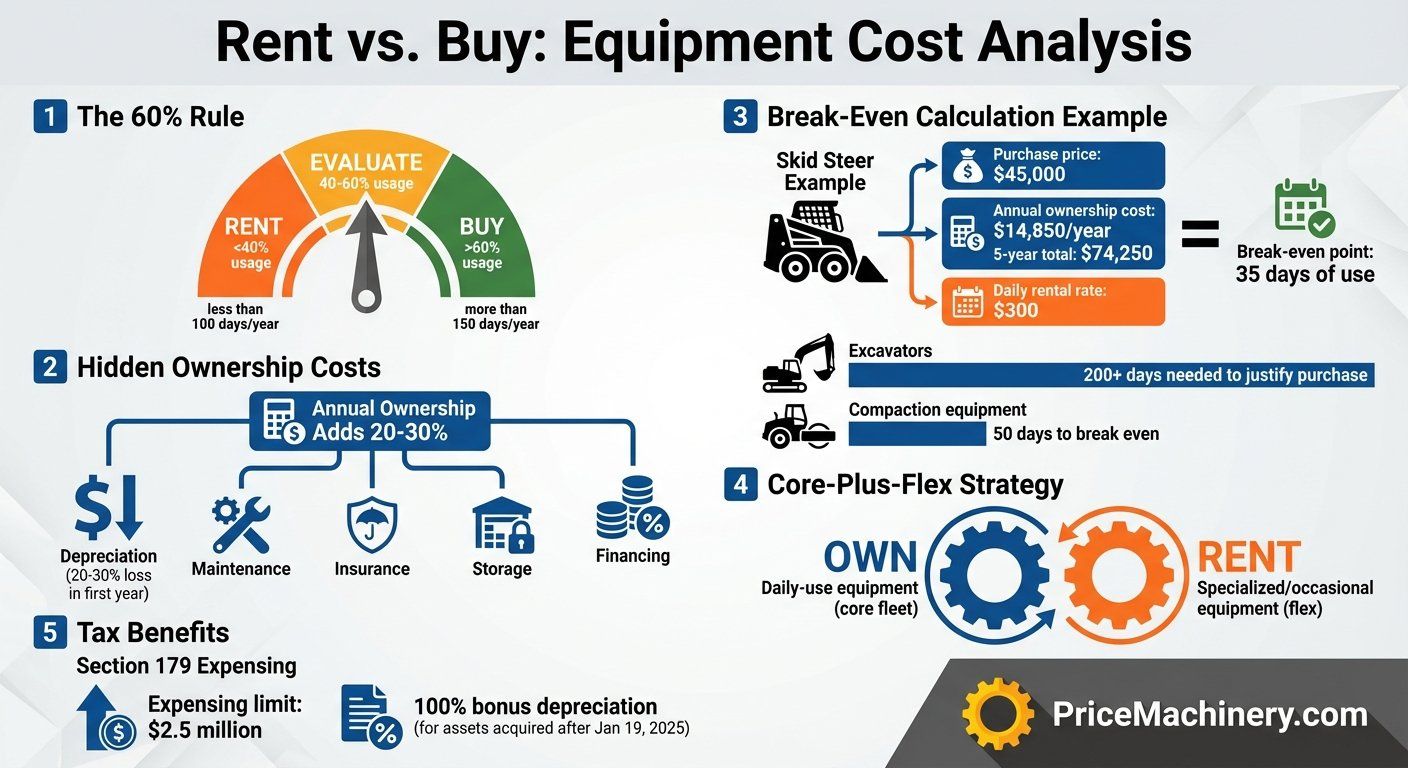
Utilization is the single most reliable indicator of whether ownership makes sense. If a piece of equipment is in active use more than roughly 60–70% of the time, ownership typically wins on cost per hour. Below that threshold, rental usually delivers better value because you pay only for the time the asset generates revenue or output.
- High utilization: Ownership spreads fixed costs across more productive hours.
- Low or seasonal utilization: Rental eliminates idle-time carrying costs.
- Unpredictable demand: Rental preserves flexibility and avoids stranded capital.
Total Cost of Ownership
Purchase price is only the entry point. A rigorous comparison must account for depreciation, maintenance, insurance, storage, calibration, downtime, and eventual disposal. Rental rates bundle many of these costs into a predictable monthly figure, which simplifies budgeting but may carry a premium over the asset’s full lifecycle.
| Upfront capital | High | Minimal |
| Maintenance | Owner’s responsibility | Typically included |
| Depreciation risk | Borne by owner | Borne by lessor |
| Upgrade flexibility | Limited | High |
| Accounting treatment | Capital expenditure | Operating expenditure |
Technology Obsolescence
In fast-moving sectors—computing, broadcasting, testing and measurement—equipment can lose relevance before it loses function. Renting shifts obsolescence risk to the lessor and lets your team refresh hardware on a predictable cadence. For stable, mature equipment with long useful lives, buying captures more value.
Cash Flow and Financing
Purchasing ties up working capital and may require debt financing, which affects your balance sheet and borrowing capacity. Renting preserves liquidity and converts capital expenditure into operating expenditure, which can be advantageous for growing companies or those managing tight margins. Run the numbers against your cost of capital before committing either way.
A Practical Decision Framework
Use the following sequence to structure your evaluation:
When Buying Is the Smarter Choice
Ownership tends to win in predictable, high-utilization environments. If your equipment runs daily, sits at the core of your service delivery, and has a long functional life, purchasing builds equity and reduces long-run cost per unit of output. Owning also gives you full control over maintenance schedules, customization, and availability—critical when downtime directly threatens revenue.
When Renting Wins
Rental excels in four scenarios:
- Short-term projects with defined end dates.
- Specialized or rarely used equipment that cannot justify ownership.
- Fast-moving technology categories where upgrade cycles are short.
- Uncertain or scaling operations that need flexibility over commitment.
Renting also functions as an effective trial mechanism. Before committing capital, teams can validate that a given equipment class delivers the expected return in their specific workflow.
Hybrid Strategies Deserve Serious Consideration
The decision is rarely binary. Many organizations adopt a mixed portfolio: owning core, high-utilization assets while renting peak-capacity or specialized equipment. Others use equipment financing or lease-to-own arrangements to bridge the two models. These hybrids capture the control benefits of ownership without overcommitting capital to every asset class.
The Bottom Line
The right decision flows from your utilization data, cost of capital, and tolerance for technology risk—not from habit or industry convention. Build a defensible model, revisit it annually, and treat the rent-versus-buy question as a recurring strategic review rather than a one-time choice. Organizations that approach equipment strategy with this discipline consistently convert the decision into a durable competitive advantage.
Leave a Reply