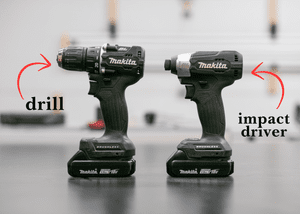
Walk into any hardware store, and you will find drills and impact drivers displayed side by side. They look similar, they both spin a bit, and they both cost money—so it is tempting to assume they are interchangeable. They are not. Understanding the mechanical differences between these two tools will save you from stripped screws, damaged materials, and wasted purchases. This guide breaks down exactly what each tool does best, so you can decide which one belongs in your toolbox—or whether you need both.
The Fundamental Difference: How They Deliver Power
At first glance, a drill and an impact driver appear to perform the same function: rotating a bit to drive fasteners or bore holes. The distinction lies in how that rotation is delivered.
A standard drill produces smooth, continuous rotational force. Squeeze the trigger, and the chuck spins at a consistent rate. This predictable power delivery makes drills ideal for tasks that demand precision and control.
An impact driver, by contrast, combines rotation with rapid, concussive blows. Internally, a spring-loaded hammer mechanism strikes an anvil thousands of times per minute, converting that rotational force into short, powerful bursts. The result is significantly more torque—typically 1,000 to 2,000 inch-pounds compared to a drill’s 300 to 800—delivered in a hammering action rather than a steady twist.
That single mechanical difference cascades into everything else: the chuck design, the bit compatibility, the applications each tool excels at, and the scenarios where each one will let you down.
What a Drill Does Best
The drill is the more versatile of the two tools, and for most homeowners, it is the one to buy first. Its key advantage is the three-jaw chuck, which accepts a vast range of accessories—twist bits, hole saws, spade bits, auger bits, and driver bits alike.
Core Applications
- Drilling holes in wood, metal, plastic, and drywall
- Driving screws where precision matters more than raw power
- Mixing paint or mortar with a paddle attachment
- Running hole saws for pipe and conduit installations
- Delicate fastening in furniture assembly and cabinetry
Modern cordless drills also feature clutch settings—a series of numbered torque limits that disengage the drive when resistance is reached. This prevents overdriving screws into softwood or stripping threads in assembly work. For finish carpentry, furniture, and any task where finesse matters, the clutch is indispensable.
Many drills also offer a hammer function for light masonry work, though this is a compromise feature rather than a substitute for a rotary hammer.
What an Impact Driver Does Best
The impact driver is a specialist—and in its specialty, nothing else comes close. Its hex collet accepts standard 1/4-inch quick-change bits, and the concussive action drives fasteners with an efficiency that a drill simply cannot match.
Core Applications
- Driving long structural screws into decking and framing
- Fastening lag bolts and heavy-duty hardware
- Assembling deck frames and fencing at speed
- Driving screws overhead or in awkward positions
- Working with dense materials where a drill would stall
The hammering action also delivers a hidden benefit: reduced cam-out. Because the bit impacts rather than twists continuously, it seats more firmly in the screw head, virtually eliminating the stripped screws that plague high-torque drilling. The trade-off is noise—impact drivers are loud—and vibration, which takes some getting used to.
Crucially, impact drivers are not designed for drilling holes. The chuck cannot grip round-shank drill bits securely, and the hammering action will damage most bits and materials. Attempting to bore a clean hole with an impact driver is an exercise in frustration.
Head-to-Head Comparison
| Chuck type | Three-jaw keyless chuck | 1/4-inch hex quick-change collet |
| Torque output | 300–800 in-lbs (typical) | 1,000–2,000 in-lbs (typical) |
| Power delivery | Smooth and continuous | Rotational plus concussive |
| Drilling capability | Excellent across materials | Not recommended |
| Screw driving | Precise, clutch-controlled | Powerful, fast, low cam-out |
| Best for | Holes, mixed tasks, finesse work | High-volume fastening, heavy screws |
| Noise level | Moderate | High |
Which Tool Should You Buy First?
If you are building a toolkit from scratch, buy the drill first. It handles the widest range of tasks—drilling, driving, mixing, and light masonry—and its clutch gives you control that beginners need. A quality 18V or 20V cordless drill will carry you through furniture assembly, shelving installation, picture hanging, and basic repairs.
Add an impact driver second if your projects involve decking, framing, fencing, or any high-volume fastening. Once you experience the speed and authority of an impact driver on structural screws, you will wonder how you managed without it.
When to Choose One Over the Other
The Verdict
Drills and impact drivers are not competitors; they are complements. The drill is the generalist—capable, controllable, and versatile. The impact driver is the specialist—brutally effective at the one job it was engineered to do. If your budget allows only one purchase, start with the drill. If your projects involve serious fastening, the impact driver will quickly earn its place beside it. Together, they form the backbone of any capable power tool kit.
Leave a Reply