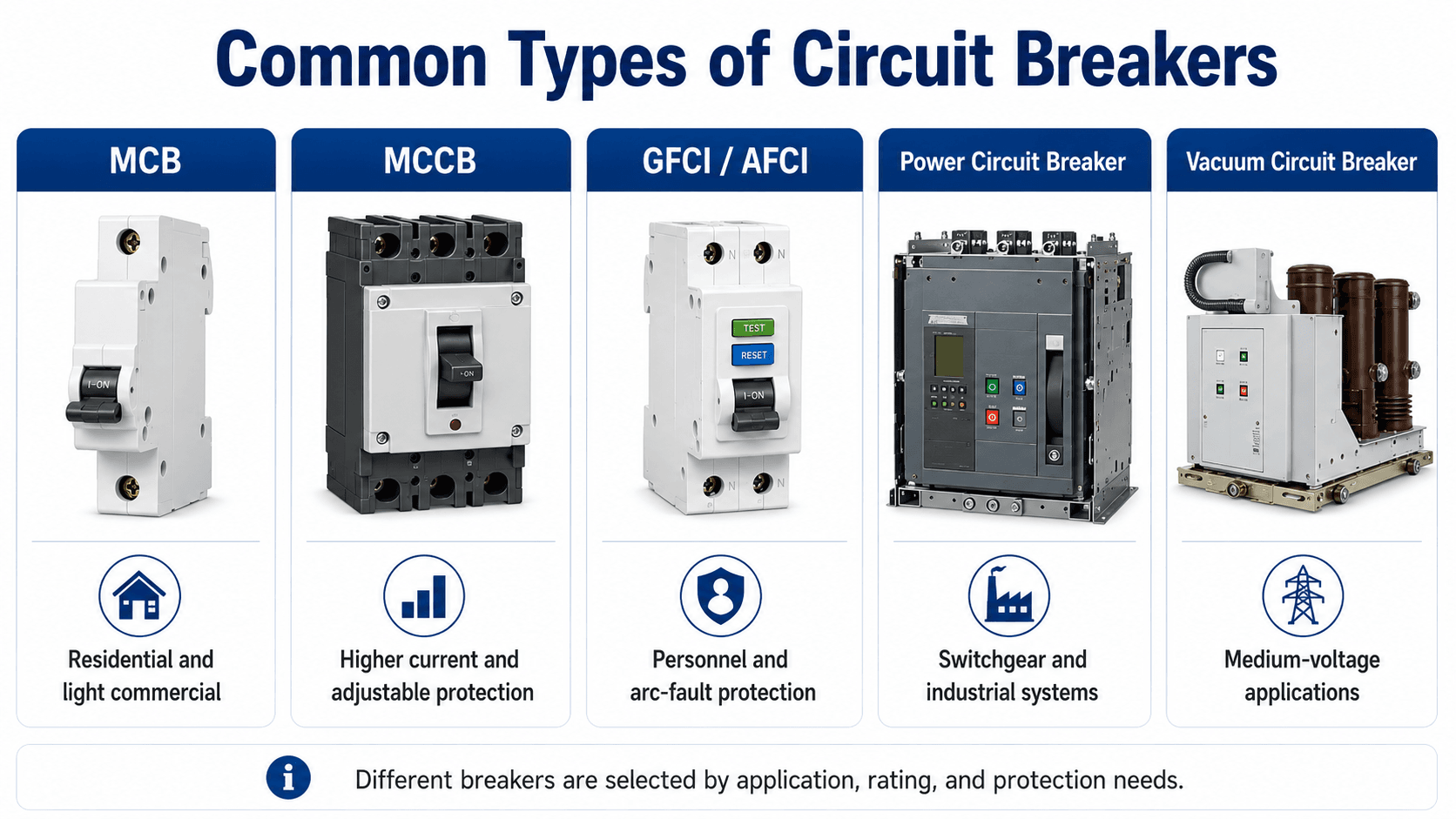
In the architecture of modern electrical and electronic systems, few components carry as much quiet responsibility as the circuit breaker. It is the silent guardian of infrastructure, standing ready to interrupt the flow of current the moment conditions turn hazardous. For engineers, facility managers, and technology professionals alike, a firm grasp of circuit breaker fundamentals is not merely academic—it is essential to designing safe, resilient, and compliant systems. This article examines what circuit breakers are, how they function, the principal types available, and the diverse applications in which they prove indispensable.
What Is a Circuit Breaker?
A circuit breaker is an automatically operated electrical switch designed to protect an electrical circuit from damage caused by excess current, typically resulting from an overload or short circuit. Its core function is to detect a fault condition and interrupt current flow. Unlike a fuse, which operates once and must be replaced, a circuit breaker can be reset—either manually or automatically—to resume normal operation once the fault has been resolved.
The device operates on a straightforward principle: when current exceeds a predetermined threshold for a specified duration, a mechanism within the breaker trips, physically separating the contacts and breaking the circuit. This interruption prevents overheating, fire, and equipment damage. Modern circuit breakers are engineered to react within milliseconds, a speed that is critical in protecting sensitive electronics and high-value industrial machinery.
How Circuit Breakers Work
Although designs vary by type and rating, most circuit breakers rely on one of two primary tripping mechanisms:
- Thermal tripping: A bimetallic strip bends as it heats up under sustained overload conditions, eventually releasing the latch mechanism. This method responds slowly and is ideal for detecting gradual overloads.
- Magnetic tripping: A solenoid generates a magnetic field proportional to the current; a sudden surge, such as a short circuit, forces the plunger to trip the breaker instantly.
- Hybrid (thermal-magnetic): Many breakers combine both mechanisms to protect against both sustained overloads and instantaneous faults.
More advanced breakers, such as electronic and intelligent models, use current transformers and microprocessors to monitor waveforms and trip with programmable precision, enabling features like adjustable thresholds, remote monitoring, and diagnostic reporting.
Types of Circuit Breakers
Circuit breakers are manufactured in a range of form factors and technologies, each suited to particular voltage levels and environments.
| Miniature Circuit Breaker (MCB) | Up to 1 kV | Residential and commercial distribution boards |
| Molded Case Circuit Breaker (MCCB) | Up to 1 kV | Industrial panels and feeder protection |
| Air Circuit Breaker (ACB) | Low voltage, high current | Main distribution and industrial switchgear |
| Vacuum Circuit Breaker (VCB) | Medium voltage (1–38 kV) | Utility substations and industrial power systems |
| SF6 Circuit Breaker | Medium and high voltage | Transmission networks and heavy-duty substations |
Each type offers distinct advantages. Vacuum breakers, for example, are prized for their compact size, long service life, and minimal maintenance requirements, while SF6 breakers excel in high-voltage transmission environments where arc-quenching performance is paramount.
Key Applications Across Industries
Circuit breakers serve a remarkably broad spectrum of applications, spanning residential, commercial, industrial, and utility domains.
Residential and Commercial Buildings
Within homes and commercial facilities, miniature circuit breakers protect lighting circuits, receptacles, and appliances. Ground fault circuit interrupters (GFCIs) and arc fault circuit interrupters (AFCIs) represent specialized variants that safeguard against electric shock and arc-related fires, respectively. These devices are now mandated by electrical codes in many jurisdictions, underscoring their role in public safety.
Industrial Manufacturing
Factories and production facilities depend on MCCBs and ACBs to protect motors, transformers, and distribution feeders. In these environments, breakers must withstand high fault currents while coordinating with protective relays to isolate faults without disrupting unrelated processes. Selectivity—the ability to trip only the breaker closest to a fault—is a critical design consideration for minimizing downtime.
Power Generation and Transmission
Utilities deploy vacuum and SF6 circuit breakers throughout substations to switch and protect transmission lines, transformers, and capacitor banks. These devices must interrupt enormous fault currents and recover dielectric strength rapidly, ensuring grid stability and protecting capital-intensive assets.
Renewable Energy and Data Centers
Solar inverters, wind turbines, and battery storage systems rely on DC-rated circuit breakers to handle direct current faults—a scenario that demands specialized arc-quenching designs. Meanwhile, data centers specify high-performance breakers to protect uninterruptible power supplies and server racks, where even brief outages carry significant financial consequences.
Selection and Safety Considerations
Choosing the appropriate circuit breaker requires careful evaluation of several parameters. Engineers should confirm the following:
Equally important is proper installation and periodic testing. Breakers should be exercised and inspected according to manufacturer guidance, and aging devices should be replaced before their reliability degrades. Safety, after all, depends as much on maintenance discipline as on product quality.
Conclusion
Circuit breakers are far more than simple switches—they are precision-engineered protective devices that underpin the safety and reliability of virtually every electrical system in modern society. From the miniature breakers in a household panel to the massive vacuum and SF6 units guarding transmission substations, these components embody decades of engineering refinement. For technology professionals, understanding their operation, types, and applications is fundamental to building systems that are not only functional but genuinely resilient. As electrical infrastructure grows more complex and distributed energy resources proliferate, the circuit breaker will remain an indispensable line of defense.
Leave a Reply