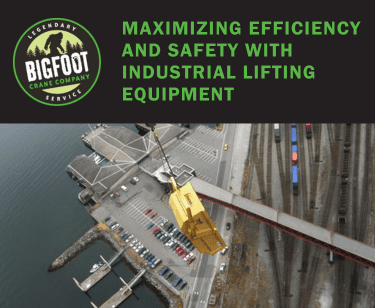
In industrial and commercial environments, efficiency is not simply a matter of working faster. It is a function of moving materials safely, reducing wasted motion, and protecting the workforce from injury. Lifting equipment sits at the center of that equation. From overhead cranes and hoists to pallet jacks, lift tables, and vacuum lifters, the right equipment transforms physically demanding tasks into controlled, repeatable operations. The result is a measurable gain in productivity, safety, and operational consistency.
Reducing Manual Handling and Physical Strain
Manual lifting is one of the most common sources of workplace injury and lost time. According to widely cited occupational safety data, overexertion and repetitive strain account for a substantial share of industrial injuries, many of which involve lifting, lowering, or carrying loads. Lifting equipment directly addresses this risk by removing the load from the worker’s body and placing it under mechanical control.
The efficiency gains are straightforward:
- Fewer injuries mean fewer lost workdays and lower workers’ compensation costs.
- Less fatigue allows workers to maintain productivity across a full shift.
- Reduced turnover lowers recruitment and training expenses.
- Broader workforce capability enables more employees to handle tasks safely.
When workers are not exhausted by repeated heavy lifting, they make fewer errors, work more steadily, and require less supervision. Efficiency improves as a direct consequence of reduced physical burden.
Faster Material Movement and Throughput
Time studies consistently show that mechanical lifting is faster than manual handling for anything beyond light loads. A hoist or crane can move a load across a facility in seconds, while manual transport requires multiple workers, careful coordination, and frequent rest breaks. The cumulative effect over a shift is significant.
Consider the difference in a typical warehouse or production setting:
| Moving a 200 kg load 20 meters | Multiple workers, several minutes, high injury risk | Single operator, under a minute, controlled risk |
| Loading a delivery vehicle | Repeated lifting, fatigue accumulating through the shift | Consistent pace, reduced fatigue, predictable timing |
| Positioning components for assembly | Manual alignment, frequent readjustment | Precise placement with lift tables or jib cranes |
Faster movement translates directly into higher throughput, shorter cycle times, and better utilization of floor space and labor.
Improved Workplace Safety and Compliance
Efficiency and safety are not competing priorities; they reinforce one another. Lifting equipment reduces the likelihood of dropped loads, crush injuries, and musculoskeletal disorders. It also supports compliance with occupational health and safety regulations, which increasingly require employers to assess and control manual handling risks.
Key compliance and safety benefits include:
A safer workplace is also a more predictable one. Fewer interruptions for incident response, investigation, and downtime mean operations run closer to plan.
Better Space Utilization and Workflow Design
Lifting equipment enables facility layouts that would otherwise be impractical. Overhead cranes free up floor space by moving loads above work areas. Lift tables allow ergonomic work heights and can be integrated into assembly lines. Vacuum lifters and manipulators handle awkward or fragile items that manual labor cannot manage reliably.
These capabilities support lean workflow principles: less walking, fewer handoffs, reduced work-in-progress, and smoother flow between process steps. When material handling is designed around mechanical assistance rather than human strength, layouts can be optimized for distance and sequence rather than for what a person can physically carry.
Long-Term Cost Efficiency and Asset Life
Lifting equipment represents a capital investment, but its total cost of ownership is typically favorable. Reduced labor requirements per task, lower injury costs, less product damage, and longer equipment lifespans all contribute to a strong return. Modern equipment also increasingly incorporates load monitoring, remote controls, and predictive maintenance features that reduce unplanned downtime.
Organizations that invest in appropriate lifting solutions often report:
- Lower cost per unit handled.
- Reduced absenteeism and overtime.
- Higher equipment availability through planned maintenance.
- Improved ability to scale operations without proportional labor growth.
Conclusion
Lifting equipment improves workplace efficiency by addressing its root causes: physical strain, slow manual handling, safety risk, and inflexible layouts. The benefits compound across safety, productivity, compliance, and cost. For organizations seeking durable operational gains, investing in the right lifting solutions, matched to the loads, environment, and workflow, is one of the most reliable efficiency decisions available.
Leave a Reply